
Why Page Builders Hurt Shopify Performance More Than You Think
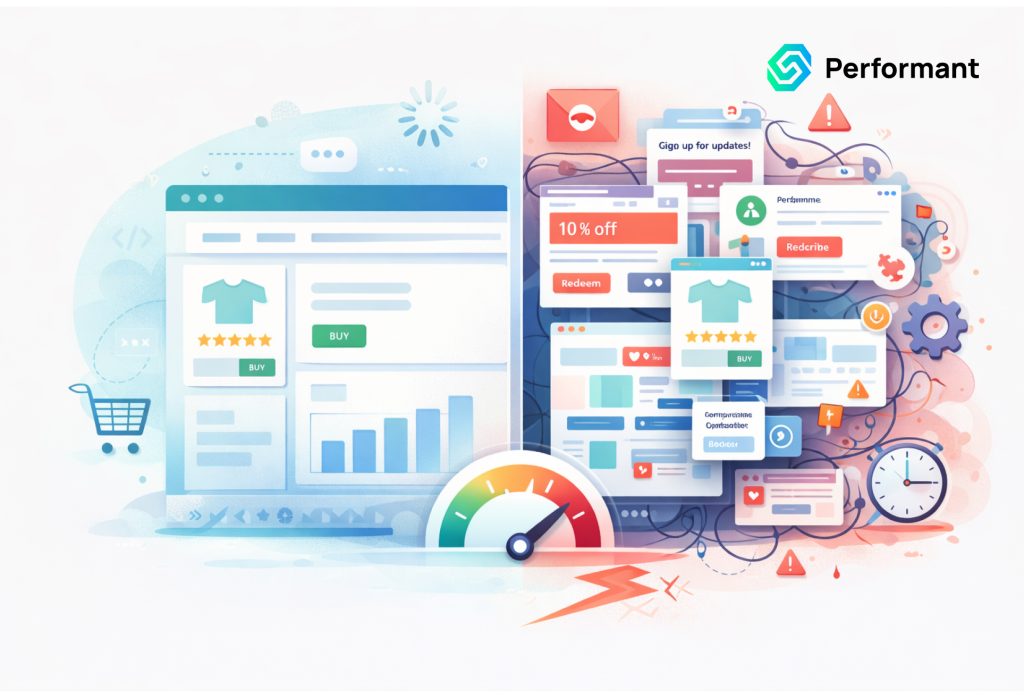
If you’re a founder using a shopify page builder to launch campaigns faster, you’re not wrong. They feel efficient. Marketing can move without Shopify developers. Landing pages ship in hours instead of weeks. But here’s the uncomfortable truth: Performance loss is a margin tax. Every extra second your store takes to load quietly increases acquisition costs, reduces conversion rate, lowers ROAS, and inflates bounce rate. You don’t see it as a direct expense on your P&L, but it compounds across every paid click. As a performance engineer who has diagnosed and contained dozens of builder-heavy Shopify stores, I can tell you this: most founders underestimate the structural cost of convenience. This article breaks down: No vendor talk. No hype. Just operational reality. Performance Loss Is a Margin Tax When you scale ads, small inefficiencies become expensive. Let’s say: That “minor” drop costs thousands per month. Often, the cause is not product-market fit. It’s not creative fatigue. It’s not even pricing. It’s page weight, script execution time, and layout instability caused by builder architecture. Performance isn’t cosmetic. It’s financial infrastructure. How a Shopify Page Builder Slows Stores Most founders think page builders are just visual layout tools. They’re not. They are runtime engines layered on top of your theme. Here’s what that means in practical terms. 1. Excessive Script Loading A typical shopify page builder injects multiple JavaScript bundles into every page it controls. These scripts: Even if your page only uses 30% of builder features, 100% of the core runtime often loads. The result: This is a common root cause of “page builder slow shopify” complaints. 2. DOM Bloat Builders generate nested containers to support drag-and-drop flexibility. Instead of: Section – Row – Content You often get: Section – Wrapper – Container – Flex Row – Column – Inner Column – Block – Text Wrapper – Text Multiply that across 40-60 sections on a long-form page and you get: Mobile devices suffer the most. This is one of the core shopify page builder issues affecting Core Web Vitals. 3. Render-Blocking Behavior Some builder scripts: That leads to: This is where shopify core web vitals page builder problems begin to show up in Lighthouse and Search Console. You don’t just lose speed. You lose stability. 4. Duplicated CSS and JS Because builders operate independently from your theme: Now add: You’re stacking multiple runtime systems on top of each other. The site becomes a script marketplace instead of a coherent application. This is one of the most overlooked shopify page builder drawbacks. The Hidden Costs Beyond Speed Speed is only half the story. Builder-heavy stores also suffer operational damage. 1. Inconsistent User Experience Because builders allow full design flexibility: This inconsistency reduces trust. Users subconsciously notice when a store feels stitched together. Brand credibility suffers. 2. QA Overhead Increases When marketing can change layout without technical oversight: Founders don’t notice until: Then the debugging begins. This is where shopify page builder issues become operational debt. 3. Fragile Updates Theme update? Something breaks. App update? Styling shifts. Builder update? Custom CSS overridden. You end up in a fragile state where: Ironically, the tool meant to increase speed reduces it long term. 4. Analytics Noise Builders often: This leads to: If your measurement layer is unstable, you can’t optimize confidently. Performance engineering isn’t just about load time. It’s about data integrity. Why Shopify Site Speed Builders Hit Harder at Scale Small stores don’t always feel the pain. But once you scale: Now your shopify site speed builders issue compounds. The system that worked at $20K/month becomes fragile at $200K/month. Scaling exposes structural weakness. Decision Framework: When Are Builders Acceptable? Let’s be balanced. A shopify page builder isn’t always wrong. Here’s when it makes sense: Acceptable Use Cases In these cases, speed of execution matters more than perfect architecture. But here’s the line: If the builder becomes core infrastructure not just experimentation you’re taking on technical debt. When It’s Time to Move to Theme Sections or Custom You should strongly consider migrating when: At this stage, builder convenience is costing you margin. The Mitigation Roadmap (Without a Full Rebuild) Good news: You don’t have to rip everything out tomorrow. Here’s how I typically contain builder damage. 1. Isolate Builder Usage Don’t let it control: Keep it limited to campaign landing pages. Reduce systemic impact. 2. Remove Unused Features Audit: Disable what isn’t actively needed. Most stores run 30 – 40% unused builder logic. 3. Consolidate CSS and Fonts Eliminate: Unify styling under your theme where possible. 4. Prioritize Core Web Vitals Focus on: You don’t need perfect scores. You need commercial performance stability. 5. Gradually Rebuild High-Revenue Pages Start with: Rebuild them natively inside theme sections. Reduce runtime dependency over time. 6. Implement Script Governance Every script should answer: If not, it shouldn’t be there. The Real Trade-Off Builders trade: Non-technical founders often optimize for speed of deployment. But when scaling, you must optimize for speed of experience. There’s a difference. A fast marketing team doesn’t matter if the site is slow. The Founder’s Perspective: What You Should Actually Do Be honest with yourself: You don’t need to become technical. But you do need visibility. If you’re spending aggressively on traffic and not auditing performance architecture, you’re flying blind. Performance Is Revenue Infrastructure A shopify page builder isn’t evil. It’s a tool. But tools used beyond their intended scope create drag. If your store feels: Builder architecture is often part of the equation. The fix doesn’t require panic. It requires clarity. Soft Next Step: Shopify Performance Cleanup Audit If you’re unsure whether your store is paying a hidden performance tax, a structured performance review can surface: A Shopify Performance Cleanup Audit doesn’t just give you speed scores. It gives you a prioritized roadmap tied to revenue risk not vanity metrics. Because at scale, performance isn’t technical. It’s financial. And ignoring it gets expensive. Conclusion In the end, a page builder is not the enemy unmanaged complexity is. What starts as a fast marketing shortcut