There is a particular kind of operational pressure that builds quietly in a scaling ecommerce business. It does not arrive as a single failure or a clear inflection point. It accumulates in the workarounds your team has stopped questioning, in the reports that never quite reconcile, in the checkout friction you have learned to explain away as normal, in the conversations you keep having about why a process that should take minutes consistently takes the better part of an afternoon.
You are doing more revenue than you were eighteen months ago. Your team is larger. Your product catalogue has grown. Your customer base is broader. And yet the business feels more brittle, not more stable. Decisions that used to be straightforward now require manual data gathering across multiple platforms. Staff onboarding takes longer because the systems are more complicated and less coherent. Customer service escalations involve tools that do not communicate with each other. The operational overhead of running the business is growing faster than the business itself.
This is not a people problem, and it is not a process problem at least not at its root. It is an infrastructure problem. The Shopify setup that carried you to your current revenue level was designed for a business that no longer exists. The gap between what your store was built to do and what your business now needs it to do is the structural source of almost every operational headache you are experiencing. And unlike a people or process problem, adding more of either will not fix it.
This article is for merchants who suspect that the gap is real, want a framework for diagnosing where the structural failures are, and are ready to think seriously about what closing them would require.
The Architecture That Got You Here Cannot Take You Where You Are Going
Every Shopify store begins as a reasonable approximation of a business. The theme was chosen because it was close enough to the brand vision. The apps were installed because each one solved a real, immediate problem. The configurations were set as best as the tools allowed. And at the time, this was the right approach because the business was simple enough that a collection of reasonable approximations was sufficient to operate it.
Growth changes that equation in ways that are rarely sudden and almost always underestimated. Your product catalogue expanded, and with it came variant complexity, bundle logic, and availability states that the standard Shopify product model was not designed to handle cleanly. Your customer segments became more distinct, and the personalisation and pricing logic those segments require cannot be expressed within the settings panels of the tools currently in place. Your fulfillment operations developed edge cases multi-warehouse routing, partial shipments, repair and return flows that the default Shopify order management structure was never designed to accommodate.
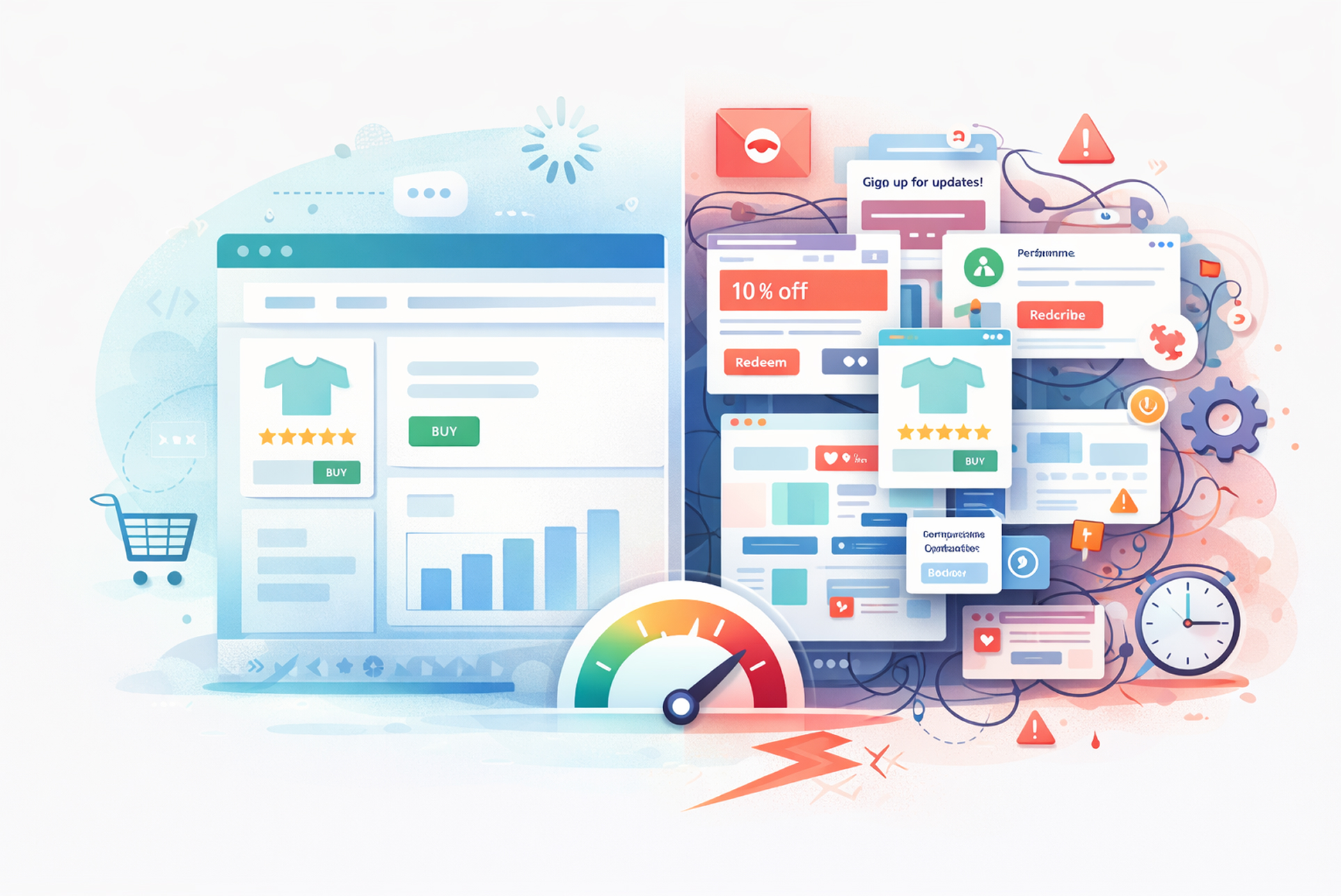
What emerges from this accumulation is not a series of isolated problems. It is a single structural problem expressing itself simultaneously across performance, operations, reporting, and cost. The storefront is slow because it is carrying too many third-party app scripts. The operations are fragmented because the tools were never designed to integrate with each other. The reporting is incomplete because the data is distributed across platforms that do not share a common schema. The monthly SaaS spend is rising because app pricing scales with revenue, and the stack that costs a manageable sum at lower volume costs significantly more now.
Each of these expressions has its own surface-level fix, another optimization pass, another middleware integration, another reporting workaround. But applying surface fixes to a structural problem does not resolve it. It delays it, at increasing cost, until the point where the accumulated weight of those workarounds becomes its own operational burden.
The Five Structural Signals Worth Taking Seriously
Diagnosing structural outgrowth requires looking at the right indicators. The following are not the only signals worth considering, but they are the ones most consistently present in Shopify stores that have genuinely outgrown their setup.
Storefront performance has plateaued despite optimisation effort. If you have worked through the standard performance interventions image compression, theme section reduction, deferred JavaScript and your Core Web Vitals scores remain weak, the remaining performance ceiling is almost certainly your app stack. Every third-party application installed on a Shopify storefront contributes JavaScript execution time, additional DNS resolution, and in many cases render-blocking behaviour. Google’s Largest Contentful Paint and Interaction to Next Paint metrics are acutely sensitive to this accumulated overhead. When theme-layer optimization has reached its limit, the constraint has moved to the infrastructure layer, and the only way to clear it is to address the infrastructure.
Your team is operating manual processes that should not exist. When staff members are regularly exporting CSVs to move data between systems, manually copying order details from one platform to another, or maintaining spreadsheets that duplicate information already held in Shopify these are not workflow inefficiencies. They are architectural gaps. The systems do not integrate because they were never designed to. The humans have become the integration layer, and they are absorbing a hidden operational cost that scales linearly with order volume.
Your business logic cannot be accurately expressed in your current tools. Tiered B2B pricing that varies by customer segment and order volume. Subscription rules that interact with loyalty tier thresholds. Fulfilment routing logic based on warehouse proximity and real-time SKU availability. If the actual rules your business operates by require workarounds, approximations, or manual overrides to implement within your current configuration, your requirements have outgrown what off-the-shelf tooling was designed to serve. This is not a limitation of Shopify as a platform, it is a limitation of the commodity layer sitting on top of it.
Conversion rate has plateaued despite ongoing optimisation investment. There is a category of conversion problem that is not caused by copy, offer, or creative; it is caused by checkout friction, page load degradation, and UX inconsistencies introduced by app conflicts and theme limitations. When a structured test-and-learn programme is producing diminishing returns and funnel analytics do not point to a clear qualitative explanation, the problem is frequently structural. The storefront itself is generating resistance that content-layer optimization cannot overcome because the source of the resistance is below the content layer.
Monthly app subscription costs have reached an inflection point. SaaS pricing is designed to scale with revenue. The apps that cost $49 per month at $300,000 in annual revenue frequently cost $299 or more at $2 million. Across a mature app stack of eight to twelve tools, the cumulative monthly spend can reach a figure that would meaningfully fund custom development. When the economics cross that threshold, continuing to pay for the flexibility of third-party apps begins to cost substantially more than owning the functionality as purpose-built tooling.
What a Proper Diagnosis Looks Like Before Any Development Begins
Identifying that a store has structurally outgrown its setup is the beginning of the process, not the conclusion. Diagnosing precisely where the failures are, in what priority order they should be addressed, and what each intervention would actually require is a distinct and more demanding exercise.
A legitimate diagnosis begins with a performance audit that goes beyond Lighthouse scores. It maps which specific apps are contributing to JavaScript payload, identifies render-blocking third-party scripts by name, and quantifies the real-world impact on Core Web Vitals under realistic traffic conditions. It examines the theme architecture to assess whether the current structure supports the business’s content and merchandising requirements or is being stretched beyond what it was designed to carry.
Alongside the performance assessment, a structural diagnosis maps every manual workflow currently in operation across the business. For each workflow, it traces the root cause back to the technology stack in which two systems are not integrated, which data is unavailable where it needs to be, which business rule cannot be expressed in the available tools. Crucially, it quantifies the operational cost of each manual process in staff time and error rate, because this is frequently the most persuasive part of the business case for investment and the one that is most consistently underestimated.
It also examines the data layer. Where is data being created? Where is it stored? Which systems have access to it and in what form? For most merchants who have outgrown their setup, the answer reveals a fragmented data architecture where customer behaviour, order history, inventory movement, and marketing interaction data are distributed across three to six separate platforms with no single source of truth and no consistent taxonomy connecting them.
This diagnostic work is where the value of engaging a qualified Shopify developer partner is most immediately visible. An experienced partner brings the pattern recognition that comes from having seen this transition across many merchants at different scales, and can distinguish quickly between what needs to be rebuilt from the ground up, what needs to be integrated more tightly, and what is functioning well enough to retain without change. Without that pattern recognition, the diagnostic process is slower, less reliable, and more likely to produce a remediation plan that addresses symptoms rather than causes.
What Changes When the Infrastructure Catches Up with the Business
The operational impact of replacing a fragmented app stack and overstretched theme architecture with purpose-built custom tooling tends to surprise merchants not because it is dramatic in any single respect, but because of how many different aspects of the business improve simultaneously.
Performance improvement is the most immediately visible change. A storefront built on a custom theme architecture, without the accumulated JavaScript overhead of a large third-party app stack, performs differently in kind from an optimised version of an overloaded standard setup. Core Web Vitals scores that were stubbornly resistant to optimisation effort move substantially when the architecture generating the problem is replaced rather than worked around. And because those scores are confirmed ranking signals in Google’s search algorithm, the performance improvement has SEO consequences that compound over time.
Operational coherence is the change that business owners consistently describe as the most significant in practice. When the core workflows of a business inventory management, order processing, customer communications, and fulfillment routing operate within a single, coherent custom layer rather than across a fragmented collection of third-party tools, the clarity that results is not a minor convenience. It reduces training requirements, reduces error rates, reduces the management overhead of maintaining multiple vendor relationships, and gives the business a substantially more accurate picture of how its systems are actually functioning.
Data ownership and portability changes in ways that have long-term strategic significance. Third-party apps store data in their own silos. When subscriptions are cancelled, that data is frequently inaccessible or exportable only in formats that are difficult to work with downstream. Custom tooling built on Shopify’s metafield and metaobject infrastructure, or connected to a merchant-owned data warehouse, keeps that data where the business controls it, a distinction that matters for analytics depth, personalisation capability, and long-term business continuity.
The pace of iteration accelerates in ways that are not always anticipated. With third-party apps, the ability to change behaviour is constrained by what the settings panel exposes and the vendor’s product roadmap. With custom tooling built on Shopify’s Admin API and Storefront API, any aspect of the functionality can be modified in hours rather than weeks. Merchants who have made this transition consistently identify iteration speed as one of the most valuable operational changes because it restores the ability to respond to market conditions and internal learnings at the pace the business actually needs.
A skilled Shopify developer partner structures this transition not as a single large-scale migration but as a phased replacement programme. The highest-impact, lowest-risk interventions come first. Performance architecture typically leads, because the revenue impact is direct and measurable. Workflow integrations follow. Data architecture consolidation comes last, because it touches the most systems and carries the highest migration complexity. This sequencing is not arbitrary; it is the approach most likely to produce stable, compounding improvement on a live business that cannot afford extended operational disruption.
Conclusion: The Setup Is a Strategic Asset, Not a Sunk Cost
The Shopify store architecture that is currently constraining your business represents a capability ceiling that will not lift on its own. Adding more apps, running more optimisation passes, and building more manual workarounds around existing limitations will continue to produce marginal, temporary improvements at increasing cost because the architecture generating the problem remains unchanged underneath each successive fix.
The merchants who navigate this transition most successfully share one common understanding: the store setup is not a sunk cost to be defended. It is a strategic asset to be actively managed, and when it is no longer fit for the business it is meant to serve, the right response is to rebuild the parts that are failing thoughtfully, systematically, and with the discipline to prioritise interventions by business impact rather than technical interest.
This is not a decision that needs to be made all at once. The phased replacement approach means that meaningful, measurable improvements are available without committing to a full rebuild and that each phase of improvement builds the business case for the next. The starting point is an honest structural assessment, not a comprehensive migration plan.
If the patterns described in this article are recognisable in your business, the most productive next step is a structured technical audit conducted by a Shopify developer partner with the platform depth to identify what is actually failing, why it is failing, and what fixing it would require. That assessment is the foundation on which everything else is built.
Find Out Exactly Where Your Store’s Architecture Is Holding You Back
We work with established Shopify merchants to conduct rigorous technical audits, identify the highest-leverage structural improvements, and build the custom tooling that removes the ceiling on growth. If your store is generating serious revenue and your operations feel harder than they should, the conversation starts with a structured assessment not a sales pitch.
Book a technical audit or explore our custom Shopify development services