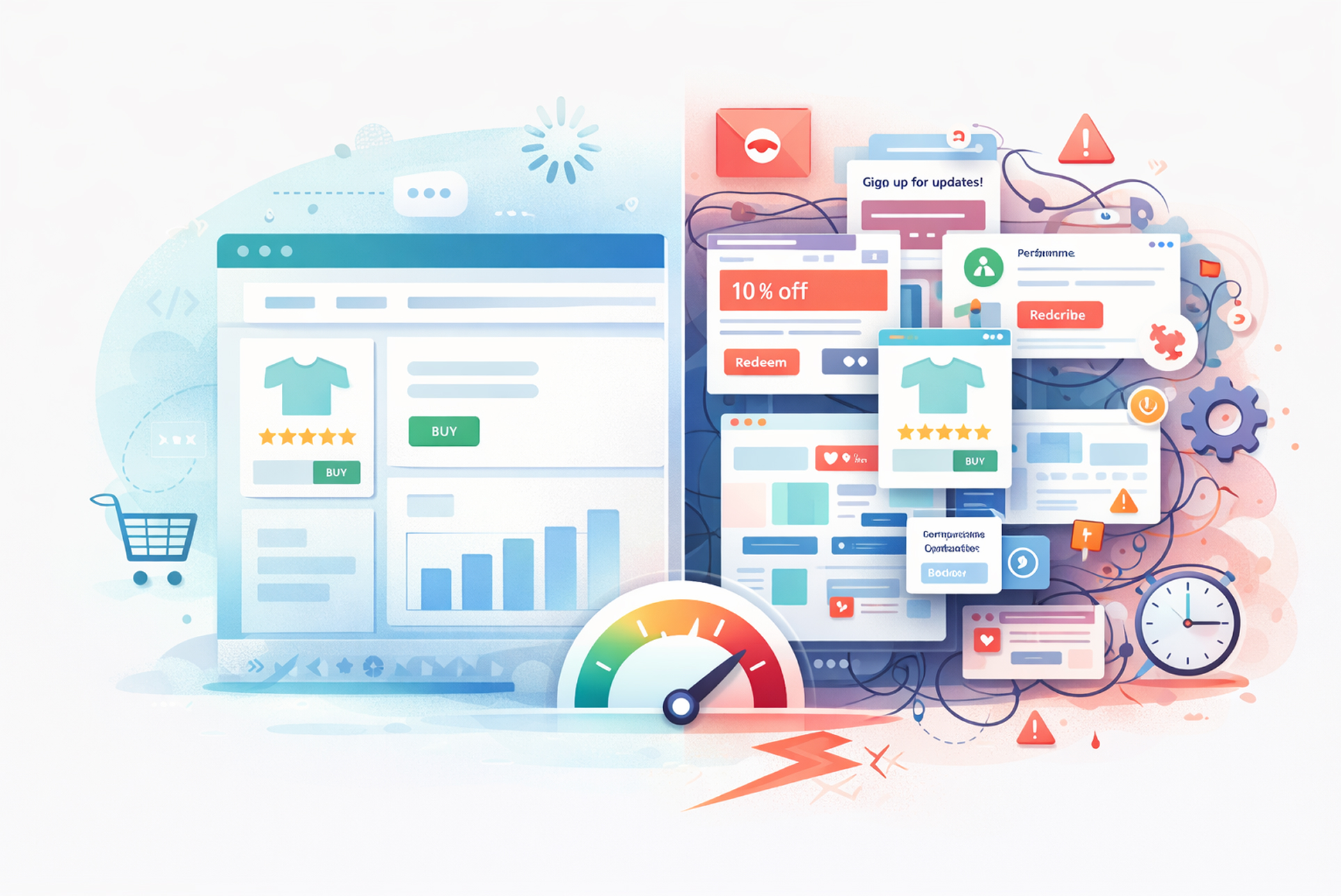
For most brands, Shopify apps are the fastest way to unlock functionality. You install, configure, and move on. In early growth stages, this speed is exactly what you need. But as stores mature, complexity compounds. What started as a handful of helpful tools can quietly become an unstable stack of overlapping logic, duplicated scripts, and rising subscription costs.
This is the inflection point where founders begin questioning their reliance on shopify apps. Not because apps are bad, but because quick wins sometimes become long-term liabilities. As a senior engineering team that regularly replaces fragile app ecosystems with maintainable systems, we have seen the pattern repeatedly. The goal is not to remove apps for the sake of control. The goal is to reduce technical drag, regain performance headroom, and align the technology layer with business strategy.
This article outlines when custom shopify development makes sense, how to evaluate the economics, what to replace first, and how to execute an app replacement strategy without risking revenue.
Apps Are Accelerators, Not Infrastructure
Apps are powerful because they compress time. Instead of building from scratch, you leverage shared development across thousands of merchants. That model works exceptionally well for common needs like email capture, reviews, analytics, shipping labels, or loyalty points.
The issue arises when growth introduces unique workflows. Mature stores often discover that multiple apps are solving adjacent problems in slightly different ways. Over time, this produces performance strain, script conflicts, and operational inconsistencies.
The conversation about shopify app limitations typically surfaces when founders notice symptoms such as slower page loads, checkout friction, data mismatches between systems, or escalating monthly subscription costs. The underlying problem is not that apps are inherently flawed. It is that your business may have outgrown generic tooling.
At scale, infrastructure needs shift from speed of installation to stability and alignment.
Replacement Trigger 1: Performance Degradation
Performance is often the first measurable signal. Each installed app can inject scripts, load assets, and introduce API calls. Individually, the impact may be minimal. Collectively, the effect can slow product pages, delay cart interactions, or degrade checkout experience.
If your store is heavily reliant on front-end injected scripts for personalization, bundling, upsells, or dynamic pricing, you may experience diminishing returns. Performance issues directly affect conversion rates and advertising efficiency. Paid traffic becomes more expensive because fewer visitors convert.
Replacing critical performance-impacting features with optimized custom logic can reduce script weight and centralize functionality. A tailored implementation ensures only necessary code runs, rather than loading generalized features designed for broad merchant bases.
When revenue is directly impacted by load time, it is no longer a tooling discussion. It is a profitability discussion.
Replacement Trigger 2: App Conflicts and Workflow Fragility
As app count increases, so does the probability of conflict. Two discount engines may attempt to override cart logic. A bundling tool may interfere with subscription billing. Inventory syncing apps may compete with ERP integrations.
These conflicts create silent operational risk. They often surface during peak traffic or promotional periods, when downtime is most expensive.
We frequently encounter stores suffering from what can be described as shopify tech debt apps. Each app solved a short-term need. None were architected together. The result is layered complexity that makes even minor changes risky.
When updates require testing across multiple app dashboards, and troubleshooting involves contacting several vendors, the stack has reached fragility. Custom consolidation can eliminate overlapping logic and centralize business rules in one maintainable layer.
Replacement Trigger 3: Vendor Risk and Dependency
Another overlooked factor is vendor stability. Apps can change pricing models, reduce support quality, pivot their product focus, or shut down entirely. Mature stores cannot afford strategic dependence on uncertain third parties.
Vendor risk becomes significant when a single app controls revenue-critical processes such as subscription billing, discount engines, or order routing. If that vendor introduces breaking changes or increases pricing dramatically, the business is exposed.
Custom shopify app replacement strategies reduce this dependency by internalizing core logic. This does not mean eliminating all third-party tools. It means controlling the systems that directly impact margin, customer experience, and data integrity.
When business continuity matters more than convenience, ownership becomes valuable.
Replacement Trigger 4: Unique or Complex Workflows
Generic apps are designed for broad applicability. If your operations are highly specialized, you may constantly be bending app configurations to approximate your needs.
Examples include advanced pricing rules, multi-layer bundling logic, complex B2B quoting systems, custom fulfillment routing, or unique subscription mechanics. When internal teams are building workarounds outside the platform to compensate for app rigidity, it is a strong indicator that custom systems are warranted.
This is where custom shopify solutions become strategic. Rather than adapting your business to software constraints, you align software to business requirements. Over time, this alignment reduces friction across marketing, operations, and finance.
If your team spends more time managing exceptions than running campaigns, your stack is misaligned.
Replacement Trigger 5: Cost Crossover Point
Subscription cost accumulation is not always obvious. A store running fifteen apps at moderate monthly fees may be paying thousands annually. Add in revenue share fees or usage-based pricing, and the number climbs.
However, raw subscription cost is only part of the equation. The more significant cost is opportunity. If apps limit experimentation speed, delay deployments, or restrict integration with internal systems, they slow growth.
The crossover point occurs when the cumulative subscription expense plus operational inefficiency approaches the cost of building and maintaining a custom system.
This is where economic modeling becomes critical.
The Economics Framework: Subscription vs Maintenance vs Opportunity Cost
Replacing shopify apps with custom systems requires financial clarity. Founders should evaluate three dimensions.
First is direct subscription cost. Calculate annual spending across all relevant apps. Include base fees, usage fees, and revenue share models.
Second is maintenance cost. Custom systems require development time for initial build and ongoing support. However, maintenance is predictable and aligned with your priorities, not a vendor’s roadmap.
Third is opportunity cost. This is often the largest factor. If your team delays launching promotions because of app constraints, if data cannot sync reliably between systems, or if conversion rate suffers due to script load, those losses compound.
A mature store should evaluate these elements over a two- to three-year horizon. Often, the initial custom investment appears large but becomes cost-efficient when amortized across years of predictable control and performance gains.
The decision is rarely about eliminating subscriptions entirely. It is about reallocating spend toward durable infrastructure.
What to Replace First
Not every app should be replaced. Commodity functionality is rarely worth rebuilding. Basic review widgets, simple analytics dashboards, or standard email capture tools often provide sufficient value without complexity.
Prioritization should focus on revenue-critical workflows. This includes pricing engines, discount logic, subscription systems, checkout modifications, inventory routing, and integrations with ERP or fulfillment partners.
If a feature directly influences margin, customer experience, or operational accuracy, it is a strong candidate for shopify custom development. If it is peripheral and stable, leave it alone.
Balanced architecture is key. The objective is not to remove apps indiscriminately. It is to consolidate and stabilize the layers that matter most.
Implementation Approach: Reducing Risk During Transition
Replacing app-based logic requires discipline. Revenue cannot be jeopardized during migration.
The safest approach involves staged rollout. Instead of ripping out an app abruptly, build custom functionality in parallel. Validate outputs against the existing system. Ensure parity in edge cases.
Parallel running allows teams to compare data accuracy and performance under live conditions. Only once confidence is established should traffic be fully routed to the new system.
Rollback planning is essential. Every deployment should include a clearly defined reversion path. If unexpected behavior emerges, reverting should be immediate and controlled.
Documentation and monitoring are equally important. Custom systems must include logging, alerting, and performance metrics. Without visibility, replacing apps simply shifts risk rather than eliminating it.
Avoid Rebuilding Commodity Infrastructure
One common mistake during shopify app replacement projects is overreach. Engineering teams sometimes attempt to rebuild everything for the sake of ownership. This increases cost and delays impact.
Commodity features that are stable, lightweight, and non-critical can remain app-based. The objective is selective replacement, not ideological purity.
Mature architecture blends custom systems for strategic logic with external tools for non-core functionality. That balance ensures resources are allocated where they produce the highest return.
Signs You Are Ready for Custom Consolidation
You may be ready to transition when:
- App conflicts require frequent manual troubleshooting.
- Performance metrics decline despite marketing optimization.
- Subscription costs meaningfully impact margin.
- Core workflows feel constrained by app configuration limits.
- Vendor risk introduces operational anxiety.
These signals indicate your store has moved from rapid experimentation to structural scaling. At that stage, infrastructure maturity matters more than installation speed.
The Long-Term Advantage of Custom Infrastructure
Custom systems provide clarity. Business rules live in one place. Data flows are predictable. Performance can be optimized holistically. Integrations are designed intentionally rather than layered incrementally.
This does not eliminate complexity. It centralizes and manages it. Over time, the store becomes easier to evolve because decisions are not scattered across multiple vendor dashboards.
For brands experiencing app sprawl, transitioning toward custom shopify solutions is less about control and more about coherence. Coherent systems scale better.
Soft Call to Action: Custom Development Assessment
If your store is experiencing performance strain, rising subscription costs, or fragile workflows, the next step is not immediate removal of apps. It is a structured evaluation.
A Custom Development Assessment maps your current app ecosystem, identifies revenue-critical logic, calculates cost crossover points, and outlines a phased shopify app replacement roadmap. It clarifies what should stay, what should be consolidated, and how to execute safely.
Apps are powerful growth accelerators. But at scale, infrastructure must evolve. The strongest Shopify brands do not abandon apps blindly. They replace them deliberately, guided by economics, performance data, and long-term strategy.
When custom systems align with business priorities, complexity decreases and scalability increases. That is when technology becomes an asset rather than a bottleneck.
Conclusion
Replacing apps is not about control for its own sake. It is about aligning infrastructure with the stage your business has reached. As complexity increases, unmanaged app stacks can quietly erode margin, performance, and operational clarity. The right move is not to remove everything, but to identify where generic tools are constraining growth and where ownership creates leverage. A disciplined evaluation, paired with staged execution, turns app sprawl into a streamlined system designed for scale. Mature brands evolve their architecture intentionally, not reactively.
Scale Faster With Confidence. Get a Free Shopify and Web Architecture Review From Performantcode.io Experts. Identify Hidden Performance Risks, Technical Debt, Cost Leaks, and Growth Blockers Before They Impact Conversions, Revenue, or Scalability.