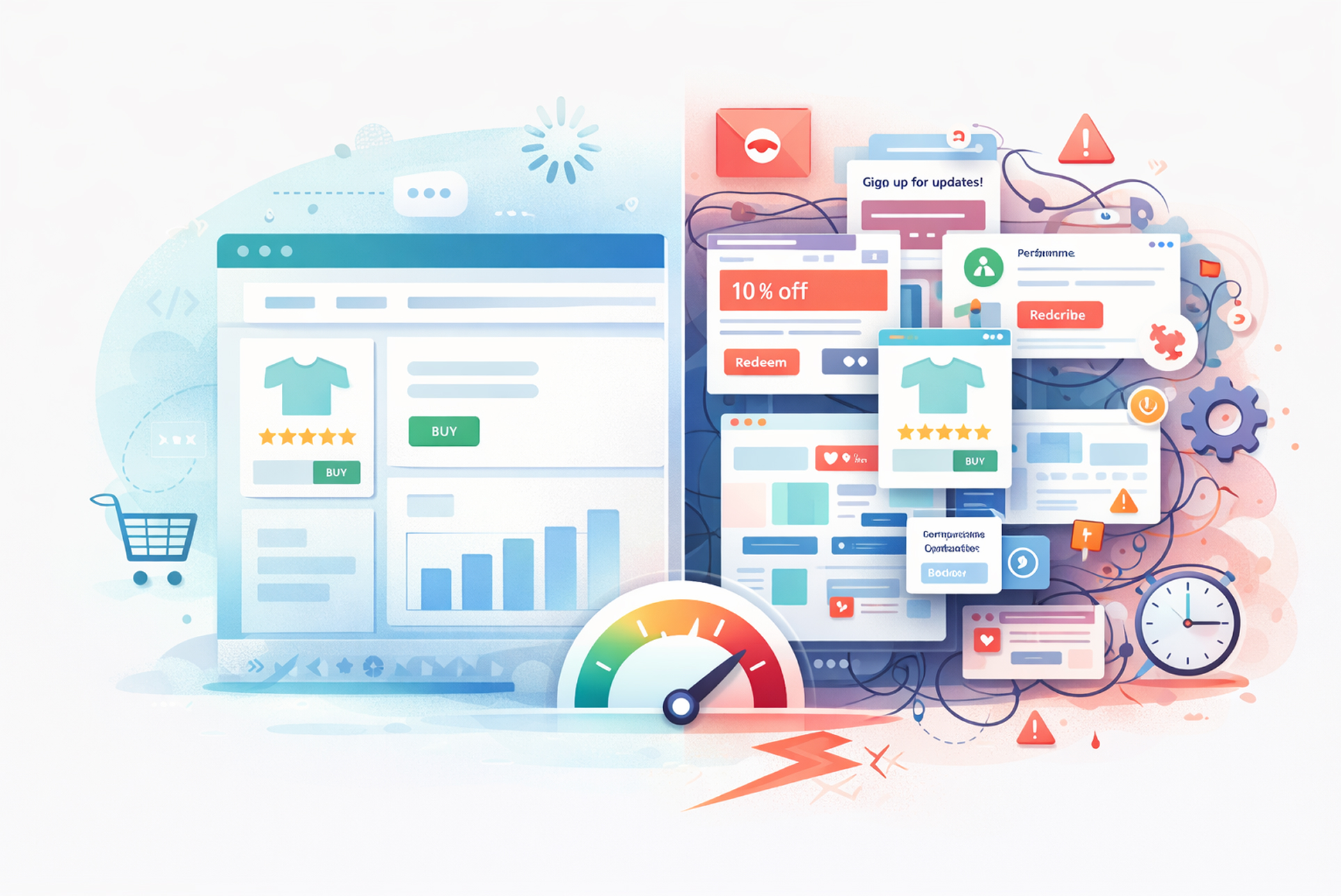
Checkout abandonment is often treated as a marketing problem. Business owners invest in better advertising, retargeting campaigns, and abandoned cart emails hoping to recover lost sales. While these tactics can help, they often overlook a deeper operational issue. In many growing WooCommerce stores, checkout abandonment is caused by technical debt that slowly accumulates over time.
Technical debt does not appear suddenly. It builds quietly as new plugins are added, integrations expand, and custom code layers on top of existing functionality. Each change may solve an immediate business need, but together they can create instability inside the checkout experience. For customers, the result is simple: the buying process becomes slower, confusing, or unreliable. When that happens, many leave before completing the purchase.
From a business perspective, this is one of the most expensive forms of inefficiency. Customers who reach the checkout have already decided to buy. Losing them due to technical friction is not a demand problem; it is a systems problem. Fixing that problem requires understanding how technical debt forms inside WooCommerce environments and how it disrupts the final stage of the purchasing journey.
Understanding Technical Debt in WooCommerce
Technical debt refers to the long-term cost created when quick solutions replace well-structured system design. In the early stages of an online store, speed often matters more than architecture. Business owners want to launch promotions, connect payment providers, integrate shipping tools, and add marketing functionality as quickly as possible.
WooCommerce makes this easy because of its vast plugin ecosystem. Thousands of extensions allow store owners to add features without writing code. While this flexibility is one of the platform’s greatest strengths, it can also create long-term complexity when plugins overlap or conflict with each other.
As a store grows, the number of installed plugins often increases. Each plugin adds scripts, database queries, and background processes. Some modify checkout fields, while others inject scripts into the order process or interact with payment gateways. Individually these changes may seem harmless, but together they increase the technical load placed on the checkout page.
An experienced woocommerce developer often sees this pattern immediately. The checkout process becomes crowded with competing scripts, redundant logic, and inefficient database calls. The system technically functions, but it becomes fragile and slower with every additional modification.
For business owners, the effects appear indirectly. Page load times increase. Checkout errors appear occasionally. Payment failures become more common. Customers abandon their carts, and the reason is rarely obvious at first glance.
Why Checkout Is the Most Sensitive Area of Your Store
The checkout stage represents the most critical point in the eCommerce journey. A customer who reaches checkout has already moved through product discovery, evaluation, and decision-making. They are prepared to complete the purchase.
At this moment, even minor technical friction can disrupt the transaction. Customers expect a checkout experience that is fast, reliable, and predictable. If a page takes too long to load or an error message appears during payment, trust disappears instantly.
Technical debt disrupts checkout in several key ways. Performance issues slow page rendering and delay form submissions. Plugin conflicts interfere with payment processing. Shipping calculations may fail to load correctly. Coupons may behave unpredictably. These small disruptions accumulate into a frustrating experience.
From a technical standpoint, the checkout page performs multiple operations simultaneously. It validates user inputs, calculates totals, verifies shipping options, communicates with payment gateways, and records the order in the database. When the system is overloaded with inefficient code or redundant plugins, this entire sequence becomes unstable.
A skilled woocommerce developer focuses on simplifying this process so that each operation executes cleanly without unnecessary overhead.
Plugin Sprawl and Workflow Complexity
Plugin sprawl is one of the most common causes of technical debt in WooCommerce stores. As businesses grow, new operational needs appear. Marketing teams want advanced discount engines. Logistics teams require dynamic shipping calculations. Finance teams request additional tax integrations.
Plugins offer quick answers to these demands. However, each new extension introduces additional code that must interact with existing systems.
Over time, a WooCommerce store may depend on dozens of plugins that all influence checkout behavior. One plugin may modify pricing logic, another may alter shipping calculations, and a third may adjust payment gateway behavior. When these systems overlap, unexpected conflicts occur.
For example, two plugins might attempt to update the same checkout field simultaneously. A shipping plugin may trigger calculations multiple times during page rendering. Payment gateway scripts may load redundantly, slowing down transaction processing.
A professional woocommerce developer typically begins a checkout optimization project by auditing the entire plugin ecosystem. This process identifies which plugins directly affect checkout performance and which can be removed or consolidated.
Simplifying the architecture often delivers immediate improvements in speed and reliability.
Performance Bottlenecks in the Checkout Flow
Performance is one of the most significant drivers of checkout abandonment. Studies consistently show that slower page load times reduce conversion rates. Even a delay of one or two seconds can cause customers to reconsider their purchase.
Technical debt often introduces performance bottlenecks through inefficient code execution. Some plugins load scripts on every page regardless of necessity. Others execute database queries that are poorly optimized for large datasets.
WooCommerce checkouts also rely on dynamic updates. When a customer changes a shipping option or applies a coupon, the system recalculates totals and refreshes order information. If these operations rely on slow queries or conflicting scripts, delays become noticeable.
Customers interpret these delays as uncertainty. When a checkout page appears unresponsive, they question whether the payment will be processed correctly.
A knowledgeable woocommerce developer analyzes performance using profiling tools that track query execution times, script loading order, and server response behavior. These insights allow developers to isolate the exact components responsible for delays.
Once those bottlenecks are removed, checkout speed often improves dramatically.
Payment Gateway Conflicts and Transaction Failures
Payment processing is another area where technical debt frequently surfaces. WooCommerce stores often support multiple payment gateways to accommodate different customer preferences. While this flexibility is valuable, it increases the complexity of the checkout environment.
Each payment gateway introduces scripts and validation logic that must interact with WooCommerce’s checkout framework. When multiple gateways load simultaneously, conflicts may occur between their scripts.
Customers may encounter problems such as incomplete transactions, authorization failures, or unclear error messages. In many cases the payment itself may succeed, but the confirmation process fails due to conflicting scripts or misconfigured integrations.
Resolving these problems requires careful debugging and system analysis. An experienced woocommerce developer reviews how payment gateway scripts interact with WooCommerce hooks and identifies conflicts introduced by other plugins.
Stabilizing payment processing significantly reduces checkout abandonment and increases customer confidence.
The Financial Impact of Technical Checkout Problems
Many business owners underestimate how much revenue is lost due to technical checkout issues. Because customers rarely report technical frustration, the problem often goes unnoticed. Analytics tools simply record an abandoned cart.
However, when checkout performance and stability are improved, conversion rates often increase immediately. Customers who previously encountered friction complete their purchases without hesitation.
Improved checkout reliability also strengthens brand credibility. A smooth purchasing experience encourages repeat business and positive word-of-mouth.
From a strategic perspective, fixing technical debt can deliver a higher return on investment than launching new marketing campaigns. The customers are already present; the system simply needs to support them effectively.
A Practical Strategy for Eliminating Technical Debt
Addressing checkout abandonment caused by technical debt requires a structured approach rather than quick patches. The process typically begins with a comprehensive technical audit.
This audit evaluates plugin dependencies, database performance, server response times, and checkout script behavior. By mapping these elements, developers gain a clear understanding of how the checkout system operates.
In many cases the most effective improvements involve simplifying the architecture. Removing redundant plugins reduces system complexity. Consolidating overlapping functionality eliminates unnecessary scripts. Optimizing database queries ensures calculations execute efficiently.
Once the architecture is simplified, performance optimization can begin. Caching strategies, script loading order, and server configurations are adjusted to ensure the checkout process runs smoothly under real-world conditions.
Testing plays an essential role in this phase. Checkout systems must be validated across devices, browsers, and network conditions to ensure consistent reliability.
Preventing Technical Debt From Returning
Eliminating technical debt is only part of the solution. Preventing its return requires disciplined system management.
Growing WooCommerce stores benefit from establishing clear guidelines for plugin adoption and custom development. Every new extension should be evaluated for its long-term impact on performance and maintainability.
Documentation is also critical. Recording how integrations and customizations interact with checkout ensures future updates do not introduce unintended conflicts.
In some cases, replacing multiple plugins with a single custom solution can simplify the architecture dramatically. When functionality is designed specifically for the store’s workflows, it becomes easier to maintain and optimize.
Collaboration with an experienced woocommerce developer ensures that future changes support the long-term stability of the system rather than adding new layers of complexity.
Monitoring Checkout Health Over Time
Even well-optimized systems require continuous monitoring. As order volume grows and integrations evolve, new performance challenges may appear.
Monitoring tools should track checkout speed, payment gateway success rates, and server response times. These metrics provide early warnings when technical problems begin to emerge.
Regular technical reviews allow business owners to address small issues before they escalate into major conversion problems. Proactive monitoring ensures the checkout experience remains fast and reliable as the store scales.
Conclusion
Checkout abandonment caused by technical debt is a common challenge in growing WooCommerce stores, but it is also highly solvable. The root of the problem is rarely customer intent. Instead, it is the gradual accumulation of plugins, scripts, and integrations that complicate the checkout environment.
When technical debt is addressed systematically, checkout becomes faster, more stable, and easier for customers to complete. Conversion rates improve, customer trust increases, and revenue grows without additional marketing expense.
For business owners, the lesson is straightforward. As your WooCommerce store evolves, maintaining technical health is just as important as expanding product offerings or advertising campaigns. A clean, efficient checkout system protects the most valuable moment in the customer journey: the instant when a visitor becomes a paying customer.
Are you ready to write code that can grow and be safe? It’s time to start using PerformantCode. We offer professional development that helps things grow faster and get results.