The Decision That Shapes Your Store’s Ceiling
Every Shopify business owner reaches a point where the platform’s default capabilities feel insufficient. A feature you need does not exist natively. A workflow your operations require cannot be automated. A customer experience you want to deliver is not possible with your current setup. The question that follows is one of the most consequential you will make for your store’s technical future: do you install an app, or do you build a custom solution, often through a trusted shopify development service?
On the surface, this looks like a simple cost-versus-convenience trade-off. In practice, it is a strategic decision that shapes your store’s performance, scalability, operational efficiency, and ultimately, its competitive ceiling. Business owners who understand this distinction make better technology investments. Those who do not tend to accumulate a growing stack of apps that conflict with each other, slow their store, inflate their monthly costs, and still fail to do exactly what the business needs.
This article lays out the full picture of what off-the-shelf apps genuinely offer, where they fall short, what custom development actually involves, and how to think about which approach is right for your specific situation at your specific stage of growth.
What Off-the-Shelf Apps Are Built to Do
The Shopify App Store contains over ten thousand applications covering virtually every conceivable eCommerce function reviews, loyalty programs, subscriptions, upsells, shipping automation, inventory management, email capture, size guides, currency conversion, and hundreds of categories beyond these. For most standard use cases, particularly in the early stages of a store’s growth, these apps solve real problems quickly and affordably.
The fundamental design principle behind off-the-shelf apps is scale. A developer builds a single solution and sells it to thousands of merchants. Because the development cost is distributed across a large user base, the per-merchant price is low. A subscription review app that might cost $30 a month to license represents a product that costs its developer tens of thousands of dollars to build. You are accessing that functionality at a fraction of its actual development cost.
This is a genuine advantage, and it should not be dismissed. For a store generating $20,000 a month in revenue, installing a $29 loyalty app that drives meaningful repeat purchase behavior is an entirely rational decision. The economics work clearly in favor of the app.
The limitations, however, are structural rather than incidental. Off-the-shelf apps are built to serve the broadest possible market, which means they are designed around the most common use cases, not your specific one. When your business requirements diverge from the common case and as you grow, they increasingly will meet the app’s constraints.
Where App-Based Solutions Begin to Break Down
The Performance Cost Is Real and Compounding
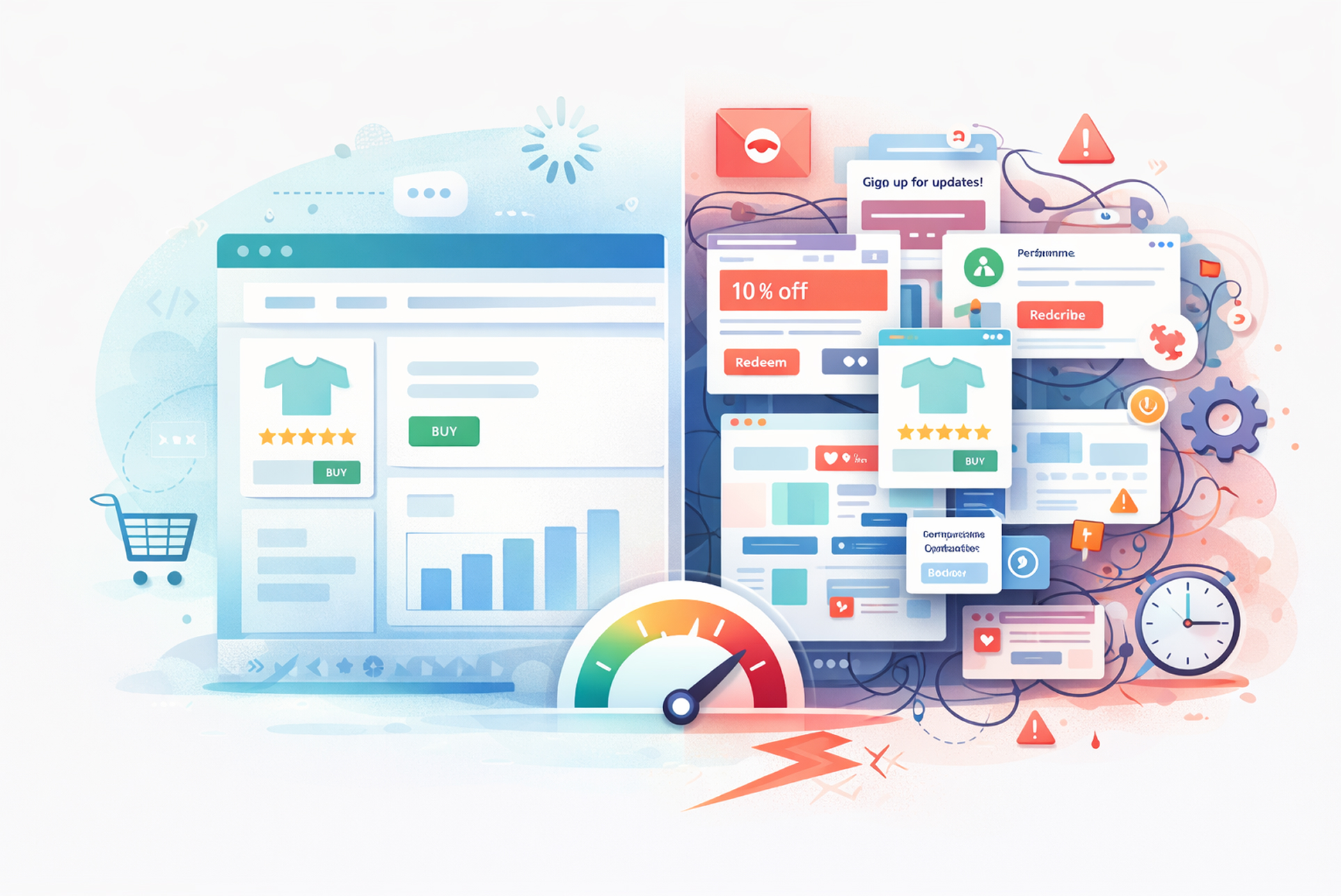
Every Shopify app you install has the potential to add code to your storefront. Review widgets, chat tools, loyalty interfaces, and upsell modules all inject JavaScript and CSS into your theme files. Individually, the performance impact of any single well-built app is manageable. Collectively, across a store running eight, ten, or twelve apps simultaneously, the cumulative effect on page load time can be severe.
This matters commercially in ways that are directly measurable. Google’s research consistently demonstrates that mobile page load time has a direct and significant relationship with conversion rate. A store loading in two seconds converts meaningfully better than the same store loading in four seconds. Every additional render-blocking script added by an app installation is a small tax on your conversion rate and those taxes compound silently as your app stack grows.
Custom development, by contrast, builds functionality directly into your theme or as tightly integrated backend logic, without the bloated generic code that consumer-facing apps carry to accommodate thousands of different merchant configurations. A custom-built loyalty module does exactly what your store needs and nothing else. It loads faster, integrates more cleanly, and does not conflict with other parts of your codebase.
App Conflicts Are an Underappreciated Risk
When multiple apps modify the same theme files as many loyalty, upsell, cart, and review apps do, the risk of conflict grows with each addition. One app’s JavaScript interferes with another’s. A cart modification made by your subscription app breaks the behavior expected by your upsell app. A theme update resolves one conflict and introduces another. Diagnosing these conflicts is time-consuming, and the solution is rarely elegant when it involves reconciling code written by different development teams for different purposes.
This is not a theoretical risk. It is one of the most common technical complaints among scaling Shopify merchants, and it is almost entirely avoidable with a well-architected custom development approach where a single team owns the full codebase and is accountable for how all components interact.
Customization Has a Hard Ceiling
Off-the-shelf apps offer settings panels with configuration options. They do not offer genuine customization. You can adjust what the developer anticipated a merchant might want to adjust. You cannot change the fundamental logic, the data structure, the user interface beyond preset options, or the integration behavior beyond what the app’s API exposes.
For a business with standard needs, this ceiling is high enough. For a business with a differentiated model, a complex B2B pricing structure, a bespoke subscription logic, a loyalty program tied to specific behavioral triggers, a product configurator with unique rules the ceiling is reached quickly, and the frustration that follows is significant. You have invested in a tool that almost does what you need, and “almost” in eCommerce is a word that costs revenue.
What Custom Shopify Development Actually Provides
Custom development is not simply “the expensive version” of an app. It is a fundamentally different approach to building store functionality, one that begins with your business requirements rather than a pre-existing feature set.
When you engage professional Shopify development services to build a custom solution, the process starts with understanding how your business actually operates. What does your checkout flow need to handle? How does your pricing logic work? What data does your team need to access, and in what format? What customer experience do you want to create that no existing app delivers? The answers to these questions become the specification for a solution built precisely to your requirements.
The practical implications of this approach are substantial. A custom-built subscription system for a business with complex product bundling logic will handle edge cases that a generic subscription app will not. A custom B2B pricing module will integrate directly with your customer account structure and product catalog in ways that a third-party app accessing your store through an API cannot fully replicate. A custom checkout extension will deliver the exact experience your brand requires without the visual compromises and behavioral constraints of an installed app.
Beyond functionality, custom development gives you ownership. The code built for your store belongs to your business. You are not dependent on a third-party developer’s pricing decisions, product roadmap, or business continuity. Apps get discontinued. Pricing models change. Features get deprecated. A custom codebase, maintained by a trusted development partner, is an asset you control.
The Economics: A More Honest Comparison
The instinct to choose apps over custom development is largely driven by upfront cost comparison, and it is worth examining that comparison more carefully than most business owners do.
A custom development project might cost $5,000 to $25,000 depending on scope and complexity. That number looks large in isolation. But consider the alternative that many scaling merchants arrive at: a stack of ten apps costing between $30 and $200 per month each. At a conservative average of $80 per app per month, ten apps represent $9,600 per year in recurring licensing costs and that figure grows as your store grows, since many apps charge on a revenue-percentage or usage basis.
Over three years, a moderate app stack can cost more than a well-scoped custom development project, deliver less precise functionality, create ongoing performance and conflict risks, and leave you with no owned asset at the end of the period. The economics of custom development become increasingly favorable as your store’s revenue scales, because the cost of custom development is largely fixed while the cost of app licensing is not.
This is not an argument that custom development is always the right answer. It is an argument that the cost comparison deserves more nuance than “apps are cheaper.” For businesses at early stages with standard requirements, apps represent excellent value. For businesses at scale with specific requirements, custom development often represents better value when the full cost picture including performance impact, conflict management, and recurring licensing is properly accounted for.
How to Think About the Decision at Your Current Stage
The right approach depends heavily on where your business is today and where it is going. A few honest questions will help frame the decision correctly.
Are you solving a standard problem or a specific one? If you need product reviews, there are excellent app-based solutions that serve virtually every merchant well. If you need a product configurator that applies custom pricing logic based on five interdependent variables and syncs with your ERP system, no app will do that cleanly. The more specific your requirement, the more the case for custom development strengthens.
What is the performance baseline of your current store? If your store is already loading slowly and you are considering adding more app-based functionality, the cumulative performance impact should be a significant factor in your decision. Professional Shopify development services can audit your current technical debt and advise on whether a custom rebuild of specific components would recover meaningful performance gains.
What is your growth trajectory? A solution that works adequately at $500,000 in annual revenue may break down at $2 million. Building on a custom foundation or migrating to one at the right inflection point is considerably easier than attempting to migrate while your store is under the pressure of high traffic and revenue volume.
Are you building a brand asset or a commodity store? Businesses investing in long-term brand differentiation in customer experience, in proprietary loyalty mechanics, in unique purchasing flows cannot fully achieve that differentiation through off-the-shelf tools designed for every merchant. Custom development is a prerequisite for genuine differentiation at the store experience level.
When the Hybrid Approach Makes Sense
It is important to note that this decision is rarely binary. The most technically mature Shopify stores typically use a combination of both approaches — well-chosen apps for genuinely standard functions, and custom development for the capabilities that define their competitive differentiation.
Email marketing integration, for instance, is a standard function served well by established app-based platforms. There is no strategic advantage in building a custom email marketing tool when proven solutions exist. But the loyalty program that drives your highest-value customer segment, the B2B pricing portal your wholesale customers depend on, or the product bundling logic central to your average order value strategy these are the capabilities worth building with precision.
Identifying which capabilities fall into which category is a strategic conversation, not a technical one. The right Shopify development services partner will help you make that distinction clearly, without pushing you toward unnecessary custom development or steering you away from it when it genuinely serves your interests.
The Partner Question
Whichever approach you choose, the quality of your development partner matters more than the approach itself. A poorly executed custom development project creates the same technical debt as a poorly chosen app stack. A well-chosen set of apps, maintained and monitored by a capable team, can serve a business well for years.
What distinguishes a development partner worth working with is not simply technical competence but strategic perspective. They should be capable of looking at your current app stack, your store’s performance data, your business requirements, and your growth objectives, and giving you an honest assessment of where each dollar of development investment will generate the most return. They should be as willing to tell you that an app serves your current needs well as they are to propose a custom solution when the situation genuinely warrants it.
The Shopify development services market is large and varied. There are boutique specialists, large agencies, and individual contractors. What matters most is finding a partner whose incentives are aligned with your outcomes, one who measures success by your store’s performance, not by the volume of development hours they bill.
Conclusion: Clarity Over Convenience
The choice between off-the-shelf apps and custom Shopify development is not a choice between cheap and expensive, or between fast and slow. It is a choice between generic and precise between solutions built for everyone and solutions built for you. At the right stage of growth, apps are genuinely excellent tools. At the wrong stage, or applied to the wrong problems, they accumulate into a liability: a slow, conflict-prone, expensive-to-maintain technical stack that constrains your store rather than enabling it. The business owners who build lasting, high-performing Shopify stores are those who understand this distinction clearly and make technology decisions accordingly. They invest in the right capabilities at the right time, with the right partners. They treat their store’s technical infrastructure as a strategic asset, not an operational afterthought.
If you are at a stage where off-the-shelf apps are no longer fully serving your requirements, or where your app stack is beginning to create more problems than it solves, that is a signal worth acting on.
The right Shopify development services partnership does not just solve the immediate problem. It builds the foundation your store needs to compete at the next level and the one after that.